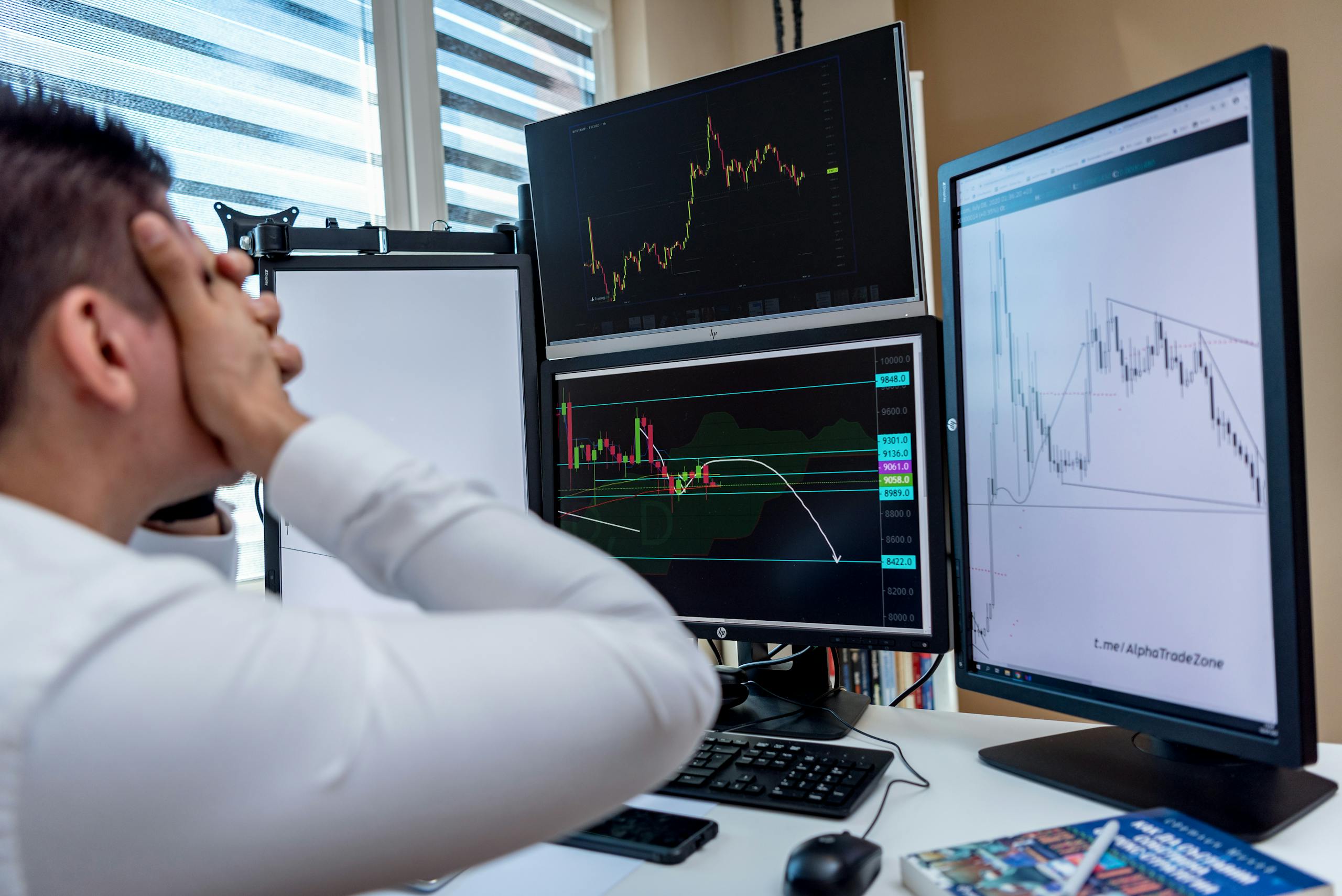
The real reason most trading strategies fail has nothing to do with Ninja Trader, indicators, or automation. It happens before the first line of code is ever written.
In our work developing custom trading systems, indicators, and modular strategy engines, we see the same pattern repeatedly: traders come to us with an idea they believe is “almost ready.” In reality, the strategy is already structurally broken. The failure is not technical. It is conceptual.
This article breaks down why most trading strategies fail before coding begins, what research says about it, and how professional system builders approach strategy design differently.
1. A Strategy Is Not a Chart Pattern (But Most Start That Way)
The majority of trading ideas begin as visual observations:
- This setup works most of the time.
- Price usually reacts here.
- This indicator confirms momentum.
The problem?
Human pattern recognition is biased.
Studies in behavioral finance show that traders consistently overestimate edge when performing discretionary chart review, due to confirmation bias and selective memory. [strategyverify.com]
When traders manually review charts:
- Winning examples stand out
- Losing examples are subconsciously dismissed
- Market regimes are assumed to be stable
As a result, many “strategies” are descriptions of what already happened, not rules that can survive repetition.
Professional system design starts with rules first, not observations.
2. Lack of a Testable Hypothesis
One of the most common reasons strategies fail early is the absence of a testable trading hypothesis.
A proper hypothesis answers:
- Why should this edge exist?
- Under what market conditions should it perform?
- What would invalidate it?
Research into systematic strategy validation shows that strategies without explicit hypotheses are far more susceptible to overfitting and data‑mining bias. [sigmentic.com], [sigmentic.com]
Without a hypothesis:
- Indicators are stacked instead of justified
- Parameters are optimized blindly
- Results look good, but break instantly in live markets
Coding a strategy without a hypothesis doesn’t reduce risk—it locks bad assumptions into automation.
3. Overfitting Begins Before the Code Exists
Most traders associate overfitting with backtesting software.
In reality, overfitting often starts at the idea stage.
Examples:
- “It works if I use exactly this EMA length”
- “It only works on this market”
- “Drawdowns disappear if I add one more filter”
Academic research shows that up to 87% of backtested strategies fail in live trading, primarily due to design‑level overfitting rather than execution errors. [sigmentic.com]
When a strategy:
- Depends on precise parameter values
- Fails outside one market regime
- Requires constant tweaking to survive
…it was fragile long before it ever reached the compiler.
4. Ignoring Market Regimes Is a Structural Design Flaw
Markets rotate between:
- Trending phases
- Range contraction
- Volatility expansion
- Liquidity compression
Yet most strategy ideas implicitly assume one permanent environment.
Professional research in market microstructure and regime dependency shows that strategy performance collapses when implicit assumptions about volatility and liquidity no longer hold. [algopolis.com], [sdk-trading.com]
If a strategy is not designed with:
- regime awareness
- adaptive logic
- or clearly defined operating conditions
…it is not “unlucky” when it fails—it is misaligned.
5. No Risk Architecture Built into the Strategy
Another reason strategies fail before coding begins:
risk management is treated as an afterthought.
Many ideas define:
- entries ✔
- exits ✔
- stops ❌
- position sizing ❌
- drawdown tolerance ❌
Research on systematic strategy failure consistently shows that risk architecture—not signals—is the dominant reason strategies collapse under stress. [backtestra.com], [tradingeng…inglab.com]
A professional strategy defines risk:
- before optimizing entries
- inside the logic
- per trade, per session, and per strategy
Without this, automation only accelerates failure.
6. Confusing Backtest Performance with Robustness
A polished equity curve is persuasive—and misleading.
Backtests validate historical behavior, not future robustness. Multiple studies in quantitative finance confirm that over-reliance on backtest metrics leads to false confidence and premature deployment. [sigmentic.com], [thesimpleportfol.io]
Common early-stage mistakes:
- Small sample sizes
- Single market testing
- Perfect execution assumptions
- Ignoring drawdown duration
A strategy that cannot psychologically or structurally survive drawdown fails regardless of its long-term expectancy.
7. Automation Exposes Weak Design—It Doesn’t Fix It
Automation removes discretion, hesitation, and bias.
Which means:
- weak logic becomes obvious
- bad assumptions execute perfectly
- errors compound faster
This is why many traders believe “automation ruined their strategy.”
In reality, automation simply exposed what was already broken.
Professional trading system development follows a design‑first approach, where logic, risk, and structure are validated before automation begins. [luxalgo.com], [arrowalgo.com]
How Professionals Prevent These Failures
At Yahtrade, every system we build follows a strict pre‑coding process:
- Clear, rule‑based hypothesis
- Explicit market assumptions
- Regime awareness
- Risk embedded at the logic level
- Modular design for testing and evolution
- Automation only after validation
This is why professional traders don’t ask “Can you code this?”
They ask “Is this strategy structurally sound?”
Final Thoughts: Failure Starts with Design, Not Execution
Most trading strategies fail before coding begins because:
- ideas are visual, not structural
- logic is assumed, not proven
- risk is added later instead of designed in
- automation is expected to fix discipline
The market does not punish bad code—it punishes weak structure.
If you want systems that survive live markets, changing regimes, and real drawdowns, you must build strategies the way professionals do: deliberately, logically, and with discipline.
Ready to Turn a Trading Idea into a Real System?
If you’re serious about moving from guesswork to execution, Yahtrade helps traders design, validate, and automate professional-grade trading strategies built for NinjaTrader and TradingView.
Book a strategy consultation and start building systems that are designed to survive.